Introduction
Picture this: your office copier dies on a Tuesday morning with a major print job due Friday. Someone finds a printer rental company online, skims the agreement, and signs. Three months later, the invoice arrives with color click charges, a supply delivery fee, and a pickup fee nobody mentioned — doubling what the rental actually cost.
Printer rental agreements are shorter and more flexible than leases, but "flexible" doesn't mean simple. Every agreement contains terms around equipment specs, usage billing, service coverage, and renewal — and the fine print on any one of them can significantly change what you actually pay.
This article breaks down the key clauses to review before signing, the red flags that signal a problematic contract, and the right questions to ask any rental provider — so you know exactly what you're agreeing to before you sign.
Key Takeaways
- Every rental agreement has terms that determine what you pay and how equipment is serviced.
- Verify the exact machine model and confirm delivery includes on-site installation and testing — not just drop-off.
- Click rates (per-page charges for B&W and color) are often the largest variable cost; get both in writing.
- Service-level agreements define technician response time — confirm parts and labor are included, not just the service visit.
- Watch for automatic renewal clauses, vague termination language, and hidden fees not listed in the advertised monthly rate.
Printer Rental vs. Lease: What's the Difference?
Many vendors use these terms interchangeably, which creates real confusion when something goes wrong.
A true rental is designed for short-term use. You can typically return the equipment before the term ends without paying out the remaining months. A lease is a fixed financial commitment — commonly 36 to 60 months, per GSA federal copier guidelines — that's harder to exit early and may include a purchase option at the end.
The simplest test: ask the vendor directly — "Can I return the equipment before the term ends, and what would I owe?" If the answer involves paying out remaining months, it's a lease regardless of what the document says.
Renting makes most sense when you need to:
- Bridge a gap while new equipment is in transit
- Handle a temporary spike in print volume (a project push, an enrollment period)
- Replace a broken machine while evaluating a permanent solution
- Cover a short-term office or event without a long-term commitment
The label on the document doesn't always tell the full story. Under UCC Article 2A, The label on the document doesn't always tell the full story. Under UCC Article 2A, legal classification depends on the substance of the agreement, not what the vendor calls it. If the arrangement is non-terminable and covers the equipment's full economic life, courts may treat it as a secured purchase — meaning you could lose early-exit rights even if the contract says "rental."
Key Clauses to Look for in a Printer Rental Agreement
Rental agreements typically cover five areas: equipment, billing, service, supplies, and contract terms. Understanding what each clause should say — and what it must not leave vague — protects you from unexpected charges and service gaps down the road.
Equipment Description and Delivery Terms
The contract should name the exact machine model and specifications — not just "multifunction printer." Rental fleets often include previously used equipment, and the specific model determines print speed, paper capacity, and network compatibility. A vague equipment description gives you no recourse if the machine underperforms.
Before signing, confirm:
- Who handles delivery, physical installation, and network configuration
- Whether driver setup is included or left to your IT team
- That the device will be tested and operational on your premises — not just unboxed and left
Ask whether the unit is new or refurbished. Southern Office Machines, for example, offers both new and refurbished Sharp equipment for rental, giving customers flexibility based on budget and need.
Rental Duration and Early Termination
Pin down exact start and end dates, and read the early termination language carefully. A fair rental contract should specify:
- How much notice you must give before returning equipment
- Whether early exit triggers a flat fee or requires payment through the end of the term
- The return procedure when the rental concludes on schedule
If paying out remaining months is the only exit option, you're looking at a lease structure, not a rental.
Meter (Click) Rates and Usage Fees
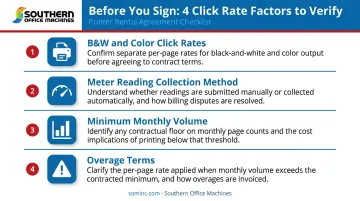
Every page printed is counted as a "click" and billed at a per-page rate. Black-and-white and color pages are priced differently, and both rates must appear explicitly in the contract.
Before signing, understand:
- B&W and color click rates — get specific numbers, not ranges
- How meter readings are collected — automatically through device software, or manually submitted by you each month
- Whether a minimum monthly volume applies — and what you're billed if you print under that threshold
- Overage terms — what happens when you exceed an included page allowance
Click charges add up quickly on high-volume jobs. A low monthly base rate can look attractive until the usage invoice arrives. Run your estimated monthly page volume against the click rates before you sign.
Service, Maintenance, and SLA Coverage
The service-level agreement (SLA) embedded in the rental contract defines what happens when equipment fails. Review it carefully.
Check for:
- Specific technician response times (same-day vs. next-business-day)
- Whether the SLA states an average or a maximum response time — a "4-hour average" measured across all calls is not the same as a guaranteed 4-hour response every time you call
- Whether coverage applies during business hours only or includes after-hours situations
- Whether parts and labor are included in the base rate or billed separately
Components like drums, fusers, rollers, and imaging units wear down over time — especially on previously used rental units. A quality agreement covers these without additional charges.
What's typically excluded: damage from user error, use of unauthorized supplies, and unauthorized equipment modifications. These usually trigger out-of-pocket service costs.
Supplies and Consumables Coverage
Most full-service rental agreements include toner and imaging-related supplies. Vendors typically exclude paper and staples — but don't assume. Ask the vendor to specify every covered and excluded item in writing.
Also clarify:
- How toner replenishment works — does the vendor monitor remotely and ship proactively, or do you request it?
- Whether supply delivery involves shipping fees
Southern Office Machines' Managed Print Services program, for instance, includes automated toner monitoring and proactive replenishment — so customers don't need to track supply levels manually. Whether that's bundled into a specific rental arrangement is worth confirming before you sign.
Renewal and End-of-Rental Obligations
Automatic renewal clauses are the single most commonly missed term in rental agreements. If you don't provide written notice by a specific deadline — often 30, 60, or even 90 days before the contract end date — the agreement rolls forward into another term automatically.
Mark that notification deadline on your calendar the day you sign.
Beyond the renewal clause, the end-of-rental logistics matter too. Confirm:
- Who schedules equipment pickup
- Who pays the pickup and removal fee
- What condition the machine must be returned in
- Whether normal wear is accepted or whether cosmetic and mechanical issues trigger charges
Red Flags to Watch Out For in a Printer Rental Agreement
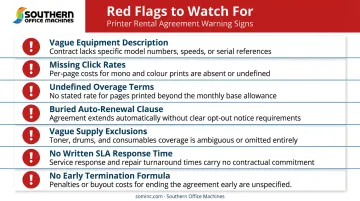
Some warning signs are obvious. Others are buried in boilerplate. Before signing, check for each of these:
- Vague equipment description: No model number, no meter reading at delivery, no condition disclosure — you have no recourse if the machine underperforms.
- Missing click rates: B&W and color per-page rates must be stated explicitly. Without them, there's no ceiling on usage costs.
- Undefined overage terms: If the contract says nothing about exceeding your included page allowance, the vendor fills that gap however they choose.
- Buried auto-renewal clause: Often tucked into boilerplate near the end. Find the specific notice deadline and put it on your calendar immediately.
- Vague supply exclusions: Phrases like "consumables not enumerated herein" can be used to deny coverage for items you assumed were included — toner, drums, waste containers.
- No written SLA response time: A verbal promise to "be there quickly" is not a contractual commitment. Response times belong in the agreement, not in a sales conversation.
- No early termination formula: If the contract doesn't spell out exactly how exit costs are calculated, that calculation defaults to the vendor's discretion.
How Southern Office Machines Makes Renting Simple
Southern Office Machines has been serving Metro Atlanta and Marietta businesses since 1985 — offering Sharp multifunction printers, copiers, and production systems through purchase, lease, and rental. Decades of working with businesses across healthcare, government, and corporate offices means they've seen firsthand which agreement terms cause problems — and which structures actually hold up.
Advisor Sheldon Michaels leads with a Business-to-Technology approach: he starts by understanding a business's workflow and print volume, then recommends equipment and agreement terms sized to those specific needs. The result is a rental structure that fits how a business actually operates — not a one-size-fits-all package.
What businesses working with Southern Office Machines can expect:
- Sharp-certified, factory-trained technicians for installation and ongoing service
- Lowest-price guarantee in the Atlanta area with no hidden fees
- Invoicing structured around each customer's billing cycle and budget
- Automated meter reading via MPS or manual meter submission — whichever works better
- Automatic toner replenishment through their Managed Print Services platform
Atlanta-area businesses ready to find the right equipment on the right terms can reach Southern Office Machines at 770-919-8989 or info@sominc.com, Monday through Friday, 9am–5pm.
Conclusion
A printer rental agreement is not a formality. The clauses around equipment specs, click rates, service coverage, supplies, and renewal terms determine whether the rental delivers value — or unexpected costs at the end of the term.
Read the agreement carefully and ask pointed questions about anything vague. That's the most direct way to protect your budget and confirm the equipment actually fits your workflow before you sign.
If you're evaluating printer rental options in the Metro Atlanta area, Southern Office Machines can walk you through agreement terms and match you with the right equipment for your volume and budget. Reach out at 770-919-8989 or info@sominc.com.
Frequently Asked Questions
What is the difference between a printer rental and a printer lease agreement?
A true rental is a short-term arrangement that can typically be ended and the equipment returned without paying out the full remaining term. A lease is a fixed financial commitment — commonly 36 to 60 months — that's harder to exit early and may include a purchase option at the end.
Are toner and supplies typically included in a printer rental agreement?
Most full-service agreements include toner and imaging-related supplies but exclude paper and staples. Ask the vendor to specify exactly which consumables are covered and how replenishment works — don't assume anything is included unless it's stated in writing.
What happens if the rented printer breaks down during the rental period?
The SLA in the rental contract governs this. It should specify technician response times and confirm that parts and labor are covered. If the SLA is vague or absent, you may be billed separately for service calls and replacement parts.
Can I end a printer rental agreement early if my needs change?
True rentals often allow early return with a notice period and possibly a flat fee, but agreements with fixed terms may require payment through the end of the contract. Review early termination language carefully — the difference between the two can mean thousands of dollars.
What fees should I expect beyond the monthly rental rate?
Common additional fees include delivery and installation, per-page click charges (especially for color), supply delivery charges, and a pickup or removal fee at the end of the rental term. All of these should be itemized in the agreement.
How are my page counts tracked on a rental machine?
Rental machines have a built-in meter that counts every page printed. Some vendors retrieve this data automatically through connected software; others require you to submit manual meter readings each month.