That blind spot is expensive. Toner, service calls, leftover leases, and idle machines add up quietly in the background while nobody's watching the meter. Print costs can eat up to 3% of a company's total revenue, according to Gartner research — money that's often invisible until someone actually goes looking for it.
A print assessment is how you find it. This guide covers what a print assessment actually evaluates, what it uncovers, and how Southern Office Machines helps Metro Atlanta businesses get one done right.
Key Takeaways
- Print assessments reveal hidden costs, redundant devices, and security gaps often overlooked
- Active print management can reduce document-output spending by 10% to 30%
- Assessments typically take one to six weeks depending on fleet size and locations
- Southern Office Machines offers free assessments backed by 40 years of Metro Atlanta service
What Is a Print Assessment?
A print assessment is a detailed evaluation of your company's current print environment — every device, every workflow, every dollar spent keeping paper moving through your office. It's typically the first step in any managed print services engagement, an information-gathering phase that happens before anyone recommends new equipment or contracts.
Think of it as a diagnostic, not a sales pitch. The goal is to understand what's actually happening across your fleet before proposing changes.
How the Process Works
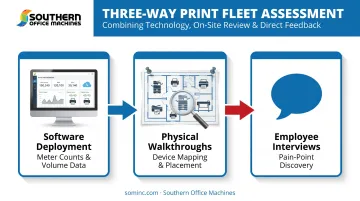
A proper assessment usually combines three methods:
- Software deployment: usage-tracking tools installed on network printers and MFPs to capture meter counts, print volumes, and color-versus-black-and-white ratios
- Physical walkthroughs: an assessor maps device locations, models, and ages against how the office actually operates
- Employee and department interviews: uncovering pain points that data alone won't show, like a printer that's always jammed or a department constantly waiting in line
Print management software varies by provider, but most fall into categories built around usage tracking, automated meter reporting, and cost analytics. No single platform is the "right" one — what matters is whether it captures accurate, representative data over time.
Assessments can be handled internally by IT staff or by an outside provider. Southern Office Machines, a Sharp-authorized dealer serving Metro Atlanta since 1985, takes a Business-to-Technology approach: learning how a company actually works before recommending a single piece of equipment.
As team member Sheldon Michaels puts it, he aims to identify "the smallest, sturdiest machine with the features and functions they need," not the biggest machine a vendor happens to be pushing that quarter.
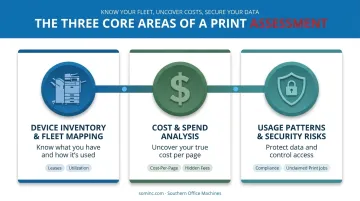
What Does a Print Assessment Cover?
The quality of a print assessment depends entirely on how much data gets collected. A shallow assessment leaves you with a shallow strategy, while a thorough one hands you real control over costs and risk.
Device Inventory & Fleet Mapping
Assessors document every printer, copier, and MFP in the building: make, model, age, and exact location. This inventory also captures:
- Lease renewal dates and current leasing costs
- Whether machines are under-utilized (sitting mostly idle) or over-utilized (constantly bottlenecked)
- Redundant devices doing the same job in the same hallway
Cost & Spend Analysis
This is where the real numbers surface. A solid assessment calculates cost-per-page, supply expenses, and software or service fees to reveal spending that rarely shows up on a single invoice.
Gartner's research on office printing cost-cutting found that paper, printing, and related costs can consume up to 3% of company revenue. That figure has stayed relevant for IT and operations budgets ever since. Most of that spend hides across dozens of small line items: toner reorders, service tickets, and leases nobody's revisited in years.
Usage Patterns & Security Risks
Usage data reveals which printers get hammered, which departments print excessively in color, and where waste is concentrated. It also exposes risk.
Security review is a critical piece of the process:
- Unclaimed print jobs sitting in output trays, visible to anyone walking by
- No "follow-me" or secure-release printing to protect sensitive documents
- Compliance gaps, particularly for healthcare clients handling PHI under HIPAA
The stakes here are real. In 2013, HHS settled a HIPAA case involving unerased copier hard drives that exposed data for up to 344,579 people — a $1.2 million lesson in why device-level security can't be an afterthought.
Key Benefits of Getting a Print Assessment
Cost Reduction. That same Gartner research found that actively managing office printing can reduce recurring document-output spending by 10% to 30%. Identifying redundant devices, renegotiating stale contracts, and eliminating waste adds up fast.
Right-Sized Equipment. An assessment shows you exactly what your workload demands — not what a sales rep guessed you'd need. That means avoiding both over-investment in machines you'll never fully use and under-investment in equipment that can't keep pace.
Improved Productivity. Optimized device placement cuts down on employees walking across the building or waiting in line at a single overloaded machine. Small friction points, multiplied across dozens of employees, cost real hours.
Stronger Security & Compliance. Once an assessment flags risks like unclaimed print jobs or missing secure-release features, a tailored plan closes those gaps, a critical step for regulated industries handling sensitive data.
Sustainability. Consolidating devices and reducing unnecessary printing cuts paper waste and energy use. ENERGY STAR-qualified imaging equipment can use up to 35% less energy than conventional models, making consolidation a win for both budgets and building operations.
How Long Does a Print Assessment Take?
Duration depends on business size, number of locations, and device count. A single office with a handful of machines moves through the process far faster than a company running multiple sites across Metro Atlanta.
The process generally breaks into three phases:
- Data collection: usage-tracking software runs long enough to capture representative volumes, typically two to four weeks
- Walkthrough and interviews: physical inventory and staff conversations, often completed in a few days
- Reporting: findings compiled into a clear cost and strategy breakdown
Provider benchmarks put small-business assessments at roughly one to two weeks, while larger, multi-location organizations can take three to six weeks to gather accurate data across every site.
Southern Office Machines aims to move efficiently without cutting corners, respecting a client's time while still gathering the depth of data needed to make real recommendations, not guesses.
Signs Your Business Needs a Print Assessment
Some warning signs are easy to spot once you know what to look for:
- Multiple printers and copiers with no centralized visibility into usage or cost
- Frequent, unexplained toner and supply reorders
- Constant service calls or recurring downtime complaints from staff
- No clear record of which leases are active or when they renew
- Departments printing in color for documents that don't need it
If your office runs a single shared printer with light volume, a full assessment probably isn't worth the effort. But once you're managing 10 or more devices, or scaling toward multiple locations, the visibility gap becomes a real cost problem.
That gap is precisely where Southern Office Machines steps in. As a Sharp-authorized dealer, the company offers a free print assessment for Metro Atlanta businesses — a low-risk way to see exactly where your money is going. Factory-trained technicians and a lowest-price guarantee back every recommendation, the same combination that's helped local businesses close this gap since 1985.
Frequently Asked Questions
What is a print assessment?
A print assessment is an evaluation of a company's print devices, usage patterns, and costs. It identifies savings opportunities, security risks, and efficiency gaps across your entire fleet.
How long does a print assessment take?
It varies by company size, but most assessments run from a few days to several weeks. Single-office setups move faster than multi-location businesses with larger fleets.
How much can a print assessment save my business?
Savings vary by fleet size and current inefficiencies, but many businesses cut print costs by 20-30% after implementing recommended changes. The exact figure depends on your device count, contract terms, and current waste levels.
Who should get a print assessment?
Businesses with multiple printers or copiers, unclear print spending, or plans to scale operations benefit most. If you're running 10+ devices without centralized visibility, it's worth pursuing.
Is a print assessment free?
Many managed print providers, including Southern Office Machines, offer free initial assessments. It's a low-commitment way to see your actual print costs before making any changes.
What happens after a print assessment is complete?
Findings typically lead to a tailored print strategy — consolidating redundant devices, renegotiating contracts, or upgrading equipment to match actual workload and budget.