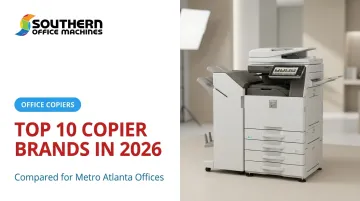
In 2026, businesses expect their multifunction printer (MFP) to route documents to the cloud, integrate with AI-driven workflows, and hold up under hybrid-work printing patterns that shift week to week. Many office managers struggle with a simpler problem: too many brands claiming to be "the best," with little clarity on what that actually means for their volume or budget.
The brand you choose affects more than print quality. It shapes document security, monthly operating costs, and how fast a technician shows up when the machine jams during a deadline crunch.
This guide breaks down the top 10 copier brands of 2026, compares them side by side, and walks through how to pick the right one for your business — not just the one with the biggest logo.
Key Takeaways
- Copier performance varies by speed, security certification, and total cost of ownership (TCO)
- Xerox, Canon, Ricoh, Konica Minolta, and Sharp lead enterprise and mid-size office segments
- For smaller, budget-conscious teams, Kyocera, Toshiba, HP, Brother, and Lexmark deliver strong value
- Print volume and service network matter more than brand name alone
- A local, factory-authorized dealer can validate which brand fits your workflow
Overview of the Copier Brand Landscape in 2026
A "copier brand" today rarely means a standalone photocopier. It means a multifunction printer that copies, prints, scans, faxes, and connects to cloud document platforms — often from a single touchscreen panel.
The market backing these devices is substantial but shifting. U.S. copier and office-equipment wholesaling reached $35.9 billion in 2025, though that figure fell 9.8% year-over-year, according to IBISWorld's industry analysis.
That contraction reflects a broader move toward managed print services and leasing, rather than one-off equipment purchases. Document output needs haven't shrunk; how businesses acquire that output has changed.
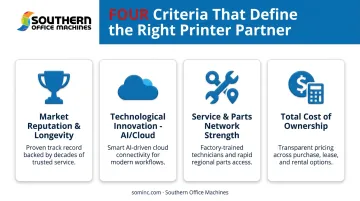
Against that backdrop, a handful of brands have kept their footing through reliability and service reach, backed by genuine innovation. The list below ranks the top 10 based on four factors:
- Market reputation and longevity
- Technological innovation (AI and cloud capability)
- Strength of the service and parts network
- Total cost of ownership over the equipment's lifespan
Top 10 Copier Brands in 2026
Speed alone won't tell you which brand fits your office. The rankings below weigh reliability testing, security certifications, and real-world service support alongside raw performance.
Xerox
Xerox has anchored document technology for more than a century, and its ConnectKey platform now functions as a hub for mobile printing, cloud scanning, and workflow automation built directly into the device. IDC named Xerox a Leader in its 2024 MarketScape assessment of cloud-managed print and document services, recognition of how far the software side has come.
Best for: High-volume offices needing dependable nationwide service.
Xerox's AltaLink and VersaLink lines split between heavy departmental printing and color-forward small office setups, backed by one of the industry's deepest service networks.
Canon
Canon built its reputation on imaging science, and the imageRUNNER ADVANCE DX series remains a benchmark for print clarity. Keypoint Intelligence named Canon's A3 lineup its 2026 A3 Line of the Year, citing consistent image quality across the portfolio.
Best for: Businesses of any size that prioritize output quality.
Canon's dealer network spans small independent shops to large regional providers, so support is rarely far away regardless of office location.
Ricoh
Ricoh pioneered several color-printing firsts, including its 1990 ARTAGE 8000, once the fastest digital color copier on the market. That engineering focus carried into today's IM C-series, built for durability under heavy daily use.
Best for: Large enterprises with global or multi-site operations.
Ricoh backs its hardware with more than 30,000 service professionals across 200 countries, according to Ricoh's global services overview. That scale is hard for competitors to match when uptime is non-negotiable.
Konica Minolta
The bizhub line unifies copy, print, color scanning, and finishing into one workflow, minimizing the handoffs that slow down document-heavy teams.
Best for: Healthcare, government, and finance organizations with strict data rules.
Konica Minolta's security credentials stand out here. Its bizhub C551i/C451i family holds Common Criteria certification under ISO/IEC 15408, with NIAP validation running through October 2026, plus AES-256 storage encryption and automatic temporary-data deletion.
Kyocera
Kyocera's ECOSYS technology uses long-life components designed to cut consumable waste and reduce maintenance frequency over the device's lifespan.
Best for: Budget-conscious small and mid-sized businesses.
Keypoint Intelligence named Kyocera the 2025-2027 Most Reliable A3 Brand after independent testing. Kyocera devices also offer strong finishing options, including booklet-making and report binding, that smaller offices often can't get elsewhere without a separate finisher.
Sharp
Sharp's OSA (Open Systems Architecture) platform lets businesses build custom workflow apps directly into the copier's touchscreen, and the interface itself feels closer to a tablet than a traditional office machine.
Best for: Offices wanting flexible, app-driven document workflows.
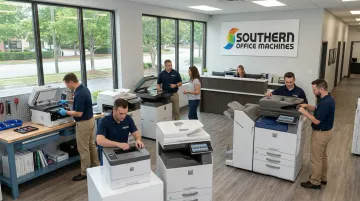
If you're in Metro Atlanta, Southern Office Machines has served as a Sharp-authorized dealer since 1985, offering sales, service, and rental across Sharp's full copier lineup, from 25-70 ppm color MFPs to production-grade systems, backed by factory-trained technicians.
Toshiba
The e-STUDIO line has built its name on straightforward reliability and easy integration into existing office networks, without demanding a major IT overhaul.
Best for: Eco-conscious businesses replacing aging fleets.
Toshiba's e-STUDIO 479CS holds ENERGY STAR certification for imaging equipment, and the e-STUDIO330AC earned a Keypoint Intelligence Outstanding A4 Color MFP pick for mid-size workgroups, proof that efficiency and performance can coexist.
HP
HP's LaserJet-based MFPs dominate the small-office and remote-workforce segment, largely because they're compact enough for a home office but still built for daily business use.
Best for: Small teams and distributed or hybrid workforces.
Built-in HP Wolf Pro Security protects endpoints across remote settings, and select color MFPs hit 26 ppm, while HP's enterprise-line devices scale up to 75 ppm for larger departments.
Brother
Brother's Workhorse series targets small businesses that need dependable output without paying for enterprise features they'll never use.
Best for: Small businesses and workgroups on a tight budget.
PCMag's 2026 laser printer testing named the Brother MFC-L3780CDW its budget-color pick, citing strong output quality at a low per-page cost. That combination keeps Brother relevant among cost-sensitive buyers.
Lexmark
Lexmark leans into cloud connectivity, with its Cloud Connector feature letting users scan directly from an MFP to a shared cloud drive without routing through a desktop first.
Best for: Growing businesses with rising paper-handling needs.
The CX963se model handles up to 4,750 sheets of input capacity at 55 ppm, giving growing offices room to scale volume without swapping hardware every year.
Quick-Reference Comparison
| Brand | Best For | Known For | Speed Range |
|---|---|---|---|
| Xerox | High-volume, multi-location offices | ConnectKey cloud ecosystem | 42-70 ppm |
| Canon | Image-quality-focused businesses | imageRUNNER ADVANCE DX series | 36-70 ppm |
| Ricoh | Large enterprise, global operations | Service network depth | 25-70 ppm |
| Konica Minolta | Regulated industries (health, gov, finance) | Certified security | 25-75 ppm |
| Kyocera | Budget-conscious SMBs | ECOSYS long-life components | 47-62 ppm |
| Sharp | Custom workflow apps | OSA platform, touchscreen UX | 25-70 ppm |
| Toshiba | Eco-conscious replacements | Energy efficiency, reliability | 35-75 ppm |
| HP | Small offices, remote teams | Wolf Pro Security, compact design | 26-75 ppm |
| Brother | Small businesses, tight budgets | Price-to-speed ratio | 48-52 ppm |
| Lexmark | Growing businesses | Cloud scanning, paper capacity | 46-55 ppm |
How We Chose the Best Copier Brands
This ranking weighs four factors equally: market reputation, technological capability, service network breadth, and total cost of ownership. Sticker price alone tells you almost nothing about what a copier will actually cost you over five years.
The most common mistake buyers make? Choosing a brand based on recognition or upfront price while ignoring:
- Local parts availability
- Real-world service response times
- Toner and maintenance costs over the contract term
- Actual print volume matched against real usage, not projected estimates
Unmanaged print environments can consume more than 3% of a company's total annual revenue once you factor in supplies, downtime, and inefficient workflows. A $2,500 entry-level MFP that breaks down weekly costs more in lost productivity than a $6,000 machine backed by same-day service.
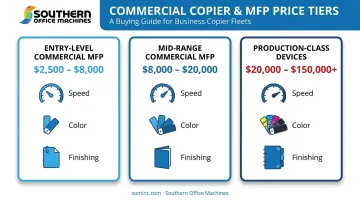
Commercial MFPs typically run $2,500 to $20,000, with production-class devices reaching $20,000 to $150,000+, according to Doceo's 2025 copier pricing guide. Where your business falls in that range depends on speed, color capability, and finishing needs, not brand prestige.
That's why validating brand claims with a local, factory-authorized dealer matters. Southern Office Machines, a factory-authorized Sharp dealer serving Metro Atlanta since 1985, knows which models hold up under regional humidity, paper stock, and usage patterns: details a manufacturer's spec sheet won't tell you.
Conclusion
There's no single "best" copier brand in 2026. The right choice depends on your print volume, security requirements, and budget — not which name is most familiar.
Before signing anything, evaluate service support, scalability, and total cost of ownership together. Request a live demo. Ask how fast a technician responds if the machine goes down during a busy week.
If you're in Metro Atlanta, Southern Office Machines has been the area's copier partner since 1985. We offer multi-brand sales, service, and rental, including a full Sharp lineup, backed by a lowest-price guarantee on every deal. Call 770-919-8989 for a free consultation, and we'll match the right machine to your actual workload and budget together.
Frequently Asked Questions
Which brand is best for photocopy machines?
Canon, Xerox, and Ricoh, and Sharp consistently rank among the top performers for reliability and print quality. The right choice ultimately depends on your print volume and budget.
What are the top printer brands?
HP, Canon, Brother, Epson, and Xerox lead the general printer market, and they overlap heavily with the top copier brands listed above.
Which copier brand is most reliable for high-volume offices?
Ricoh, Xerox, and Canon and Sharp perform well in heavy-duty, high-volume printing environments, thanks to durable hardware and strong service networks.
Is it better to buy new or refurbished copiers from top brands?
Refurbished units from reputable brands can save 40-60% with proper servicing, making them a smart option for budget-conscious buyers. New units suit businesses that need the latest security and cloud features.
How do I choose the right copier brand for my Atlanta-area business?
Assess your print volume, security needs, and budget first. Then consult a local, factory-trained dealer like Southern Office Machines, which can match those needs to the right Sharp model for your business.
How much does a commercial copier from a top brand typically cost?
Entry-level commercial MFPs generally run $2,500 to $20,000, while high-volume production models can reach $20,000 to $150,000+, depending on speed, color capability, and finishing options.