There's no universal right answer. A Marietta law firm with stable, high-volume print needs has completely different priorities than a growing Buckhead startup watching every dollar of working capital. Getting this wrong can lock your business into an expensive or outdated arrangement for years.
This guide breaks down both options honestly — including the hidden costs most businesses miss — so you can make a decision that actually fits your operation.
Key Takeaways
- Leasing preserves cash flow with predictable payments — but costs more over time and builds no ownership equity
- Buying costs more upfront but delivers lower long-term costs, full ownership, and Section 179 tax deductions
- Leasing fits tight cash flow, frequent technology upgrades, or shorter equipment timelines
- Buying suits stable, high-volume operations with capital available and a multi-year equipment plan
- Total cost of ownership — not just the monthly payment or sticker price — is the number that matters
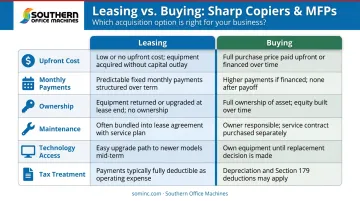
Copier Lease vs Buy: Quick Comparison
| Factor | Leasing | Buying |
|---|---|---|
| Upfront Cost | Little to none; often just a first-month fee | Full purchase price or financed amount |
| Monthly Payments | Fixed payments for the lease term | No ongoing payment after purchase |
| Ownership | Leasing company retains title; buyout option may exist | Full ownership from day one |
| Maintenance | May be bundled or available as an add-on | Owner's responsibility; service contract optional |
| Technology Access | Easier to upgrade at end of term | Requires new purchase to upgrade |
| Tax Treatment | True lease payments may be deducted as rent | Section 179 deduction or depreciation available |
On equipment cost context: Workgroup color MFPs typically start around $3,000–$5,000, while departmental and production-class systems can reach $14,000 to $42,000+. Knowing where your equipment falls on that range directly shapes whether leasing or buying makes financial sense for your business.
What Is Copier Leasing?
Copier leasing is a contractual arrangement where your business pays a fixed monthly fee to use a machine for a set term — typically 24 to 60 months — without taking ownership. It's distinct from short-term rental (days or weeks) and designed for ongoing operational use.
The Financial Logic Behind Leasing
The main appeal is straightforward: you avoid a large upfront purchase. Instead of committing thousands of dollars to a commercial-grade machine, leasing spreads that cost across monthly payments. That keeps working capital available for payroll, inventory, and everything else the business demands.
Georgia's statewide MFP contract — which governs public-sector equipment procurement — offers 24-, 36-, 48-, and 60-month lease options, which reflects what's commonly available in the commercial market as well.
What Leasing Includes (and What It Doesn't)
Lease agreements vary considerably in what they cover, and the gaps often catch businesses off guard. Some bundle maintenance, toner, and a monthly page allowance into one payment. Others — like Canon's standard finance form — place maintenance and replacement parts squarely on the customer.
Before signing any lease, clarify:
- Whether maintenance and service are included or separate
- What the monthly page volume limit is and what happens when you exceed it
- Whether toner and supplies are covered or billed separately
- End-of-term notice requirements and auto-renewal conditions
Pros of Leasing
- Low barrier to entry with minimal upfront cost
- Predictable monthly payments simplify budgeting
- Easier access to current technology with upgrade options at term end
- True lease payments may be deducted as a business operating expense
- Maintenance can often be structured as an add-on or bundled service
Cons of Leasing
- Higher total cost over time due to financing charges built into the lease
- No ownership equity unless a buyout is exercised at term end
- Overage fees apply if print volume exceeds contracted limits
- Early termination typically requires paying the remaining lease balance
- Auto-renewal clauses are common; Canon's standard lease form requires 60 days' written notice to avoid automatic month-to-month renewal
- Some cancellation windows run 90 to 180 days before term expiration — missing the deadline locks you in
Those cons don't disqualify leasing — they just mean it fits some businesses better than others.
When Leasing Makes More Sense
Leasing is the stronger fit when:
- Cash flow is tight and capital needs to stay liquid
- Your technology requirements are likely to evolve in the next few years
- You want maintenance and service handled without managing it internally
- Your business is in a growth phase with uncertain long-term commitments
What Is Buying a Copier?
Buying means outright ownership, paid in full or financed, with immediate title, full control, and no ongoing lease obligation. Both new and refurbished equipment are viable options, and that distinction meaningfully affects what you pay upfront.
The Financial Logic Behind Buying
The upfront cost is real, but so is the long-term payoff. Once the machine is paid off, there are no monthly financing charges. For businesses with stable, high-volume print needs that plan to use the same machine for several years, buying typically produces a lower total expenditure than leasing over the same period.
Tax Advantages Worth Knowing
Purchased copiers may qualify for the Section 179 deduction, which allows businesses to deduct the full purchase price in the year the equipment is placed in service rather than depreciating it over time. IRS Rev. Proc. 2025-32 sets the 2026 Section 179 maximum at $2,560,000, with phaseout beginning above $4,090,000 of qualifying property placed in service. The IRS classifies copiers as 5-year GDS property for depreciation purposes.
Note: Section 179 applies to qualifying property placed in active business use with more than 50% qualified business use. Consult a tax professional for your specific situation.
Pros of Buying
- Full ownership and asset equity from day one
- No contractual restrictions on usage volume or hours
- Section 179 deduction or depreciation options available
- Freedom to resell, trade, or modify the equipment
- Lower total cost over the machine's working life
Cons of Buying
- Significant upfront capital required
- Maintenance and repairs are the owner's responsibility without a service contract
- Technology can become outdated without a planned upgrade path
- Upgrade requires funding a new purchase
Total Cost of Ownership: The Number That Actually Matters
The purchase price is just the starting point. Maintenance agreements, toner, supplies, and repair calls all factor into what you actually spend over the machine's working life. Without a service contract, an unexpected repair can hit hard. Businesses that plan only around the purchase price routinely underestimate true ownership costs.
When Buying Makes More Sense
Buying is the stronger fit when:
- Your print volume is stable and predictable
- You have capital available and plan to use the same machine for several years
- Asset ownership and tax depreciation benefits align with your financial strategy
- You want full operational control with no usage restrictions or contract obligations
Which Option Is Right for Your Business?
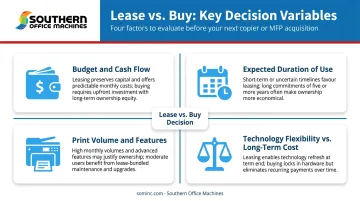
Four variables drive this decision more than anything else:
- Budget and cash flow — Can you commit capital upfront, or does that money need to stay liquid?
- Expected duration of use — A machine you'll use for two years looks very different from one you'll run for six
- Print volume and feature requirements — High-volume, predictable users get more value from ownership; lower or variable-volume operations may find leasing more practical
- Technology flexibility vs. long-term cost — If staying current matters more than minimizing total spend, leasing has the edge; if ROI over time is the priority, buying usually wins
Watch These Hidden Costs
Leasing hidden costs go beyond the monthly payment. Watch for:
- Overage fees when print volume exceeds contracted limits
- Return shipping costs at lease end, which typically fall on the customer
- Cumulative financing charges built into every payment over the lease term
Buying hidden costs start after the purchase price. Maintenance contracts, toner, and repair calls all add to your true cost of ownership — especially without a service agreement. A single repair call can cost more than a full year of maintenance coverage would have.
How Southern Office Machines Approaches This Decision
Southern Office Machines has been helping Metro Atlanta businesses navigate exactly this question since 1985. Their Business-to-Technology approach — developed by team members like Sheldon Michaels — starts by understanding each client's actual business model and workflow before recommending any equipment or acquisition structure.
The methodology is straightforward: identify the smallest, sturdiest machine that fits the business's actual needs, then calculate true total cost of ownership — factoring in maintenance, toner, service responsiveness, and how long the equipment will realistically stay in use.
For Atlanta-area businesses ready to evaluate their options, Southern Office Machines offers:
- Purchase, lease, and rental options across the full Sharp MFP lineup (color, B&W, and production printers)
- New and refurbished equipment to fit different budget requirements
- Maintenance agreements available monthly, quarterly, or annually
- Factory-trained on-site technicians plus remote support via LogMeIn Rescue
- Lowest-price guarantee for the Metro Atlanta area
Conclusion
Neither leasing nor buying is the right answer for every business. Leasing wins when flexibility, cash flow, and technology access matter most. Buying wins when long-term cost minimization, full control, and asset ownership are the priority.
The real risk is committing to either option without accounting for total cost of ownership, contract terms, and how your actual print volume affects the numbers over time.
If you're based in Metro Atlanta or Marietta and want a straightforward conversation about which option fits your business, reach out to Southern Office Machines at 770-919-8989 or info@sominc.com. They'll walk through a real TCO analysis with you — no sales pitch, just the numbers.
The team is available Monday through Friday, 9am to 5pm.
Frequently Asked Questions
Frequently Asked Questions
Is it better to lease or buy a copier?
It depends on your budget, print volume, and how long you need the machine. Leasing suits businesses prioritizing cash flow and flexibility, while buying typically delivers better value for stable, long-term users with capital available. Neither option is universally better.
How much does a copier lease cost?
Monthly lease costs vary based on machine type, features, and term length. Entry-level workgroup MFPs typically run $50–$150/month; mid-range color MFPs average $150–$400/month; production-class systems can reach $500–$1,500/month or more. Service agreements and overage fees often add to the base payment.
Can you get out of a copier lease?
Early termination is generally possible but comes with real financial consequences. Most standard lease agreements make the remaining balance — including unpaid payments and applicable costs — due upon default. Review contract terms carefully and clarify cancellation conditions before signing.
What happens at the end of a copier lease?
Typical end-of-lease options include returning the machine, purchasing it at fair market value, upgrading to a new lease, or extending the current term. Auto-renewal clauses are common — some require 60 to 90+ days' advance written notice to avoid an automatic renewal.
Are copier lease payments tax deductible?
Payments under a true lease may be deducted as a business operating expense. If the IRS reclassifies the arrangement as a conditional sales contract, the equipment is treated as purchased and recovered through depreciation instead. Consult a tax professional for your specific situation.
What is typically included in a copier lease agreement?
Coverage varies by provider and contract. Some leases bundle equipment, a monthly page allowance, and maintenance into one payment; others separate maintenance as an additional cost. Always confirm what is and is not included in writing before signing.