Introduction
Copier lease agreements are full of language most business owners never see anywhere else: fair market value clauses, minimum click charges, escalation caps, lease assumption.
Many companies sign without understanding a single one of these terms, then discover the real cost of that oversight months later.
A GSA review of federal copier contracts notes that lease terms can run anywhere up to 60 months, which means a bad decision on day one can follow you for five years.
This guide breaks down every major term you'll encounter, from lease structures to hidden fees to exit clauses, so you can negotiate from a position of knowledge instead of guesswork. Southern Office Machines has helped Metro Atlanta businesses navigate exactly these decisions since 1985, and this guide reflects that hands-on experience.
Key Takeaways
- FMV and $1 Buyout leases lead to very different cost and ownership outcomes.
- Print volume allowances, service bundling, and escalation clauses can reshape your real monthly cost.
- Automatic renewal and termination clauses cause the most expensive surprises for unprepared businesses.
- A provider who discloses every fee upfront is your best defense against hidden charges.
Understanding Copier Lease Types: FMV vs. $1 Buyout
Nearly every copier lease you'll be offered falls into one of two financial structures. Picking the wrong one for your business situation can cost thousands of dollars over the term.
Fair Market Value (FMV) Lease
An FMV lease keeps your monthly payment lower because you're not financing the full cost of the equipment. At the end of the term, you get three choices:
- Return the machine
- Renew the lease
- Purchase it at its then-current fair market value
Here's the catch: "fair market value" is often vague, undefined language. Leasing companies sometimes lean on that ambiguity to set an inflated buyout price. Negotiate a clause allowing an independent third-party appraisal before you sign. It's the simplest way to protect yourself from a number pulled out of thin air.
$1 Buyout (Capital) Lease
A $1 buyout lease works the opposite way. You pay more per month, but you're guaranteed ownership of the equipment for a nominal $1 fee once the term ends. There's no appraisal, no negotiation, no uncertainty.
This structure suits businesses that:
- Plan to keep the same equipment long-term
- Want to avoid future purchase negotiations entirely
- Prefer predictable ownership over lower short-term payments
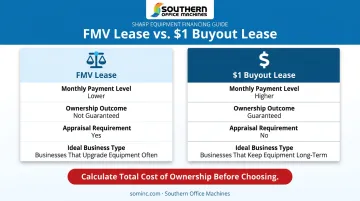
| Factor | FMV Lease | $1 Buyout Lease |
|---|---|---|
| Monthly payment | Lower | Higher |
| Ownership at term end | Not guaranteed | Guaranteed |
| Best for | Businesses that upgrade often | Businesses that want to keep equipment |
Before choosing either structure, calculate total cost of ownership: monthly payment multiplied by the term, plus any buyout cost. At Southern Office Machines, we match your usage patterns and budget to the right lease structure. This business-to-technology approach ensures you're not locked into a five-year commitment that doesn't fit how your office works.
Key Terms Every Copier Lease Agreement Should Define
Beyond the monthly price tag, several embedded terms determine what you're actually paying and getting. Miss one, and you're likely to end up in a dispute later.
Lease Term Length
Copier lease terms commonly range from 12 to 60 months. GSA guidance confirms that federal copier leases cannot exceed 60 months, and that same ceiling shows up frequently in private-sector agreements too.
Longer terms mean lower monthly payments. Shorter terms mean more flexibility. Instead of chasing the lowest payment, match your term length to your technology refresh cycle and your growth trajectory. A rapidly scaling business locked into a 60-month lease may find itself stuck with undersized equipment by year three.
Monthly Payment Structure & Print Volume Allowances
Leases typically come in two billing formats:
- Bundled: equipment, toner, and service combined into one payment
- Unbundled: each component itemized separately
Ask for a full breakdown either way. Bundled pricing feels simpler, but it can hide markups that itemized billing would reveal immediately.
Most leases also set a base monthly print volume allowance, with per-page overage fees kicking in once you exceed it. A 2024 public-contract award in Rockland County priced per-click rates at $0.0272 for black-and-white and $0.0370 for color, including maintenance and consumables. That's a useful reference point for comparing quotes, not a universal benchmark.
Service & Maintenance Agreements
Service agreements are usually separate from the lease financing itself, but they cover:
- Preventive maintenance
- Repairs and replacement parts
- Toner replenishment (in many agreements)
Before signing, confirm exactly what supplies are included and what response-time guarantees the provider commits to. A vague service clause can leave you waiting days for a repair on equipment your team depends on daily.
Costs, Fees, and Hidden Charges to Watch For
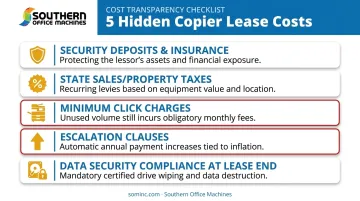
The monthly rate on your quote rarely tells the whole story. Here's what tends to show up later:
- Security deposits, installation fees, and insurance requirements: often missing from the initial quote, added once paperwork begins
- State sales or property taxes on the equipment, which vary by jurisdiction
- Minimum click charges: a required monthly volume you pay for regardless of actual usage. Oversized machines chosen to chase a lower rate often backfire here
- Escalation clauses: annual increases to service costs, often uncapped. One 2024 public RFP capped increases at 3% or local CPI, whichever was lower
- Data security compliance at lease end: certified data-wiping to meet HIPAA or similar requirements before returning the machine
That last point deserves attention. The FTC specifically warns that digital copiers retain document data on internal hard drives, and businesses need to address that data before returning a leased unit. Sharp equipment leased through Southern Office Machines includes built-in end-of-lease data erasure with AES encryption and multi-pass overwriting, so this step doesn't become a last-minute scramble.
Before signing anything, request a complete written fee disclosure. Transparent, tailored invoicing, central to our "YES To Our Customers" philosophy and lowest-price guarantee, exists to keep these surprises off your desk in the first place.
Termination, Renewal & End-of-Lease Options
Two clauses cause more disputes than anything else in a copier lease: automatic renewal and early termination.
Automatic renewal clauses require written notice within a specific window before your term ends — often 60 to 90 days, though the exact figure varies by contract. Miss that window, and you could be locked into another full term without meaning to. Set a calendar reminder the day you sign, not the month your lease is scheduled to expire.
Early termination typically works through one of three paths:
- Paying off the remaining balance in full
- Arranging a lease assumption or transfer to another party
- Negotiating a buyout with the leasing company
Penalties can equal several months of remaining payments, so read this clause closely before you're in a situation where you need it.
Not every lease ends early, though. When the term runs its full course, you'll generally face three choices:
- Return the equipment
- Purchase it at a predetermined or fair-market price
- Renew or upgrade to newer equipment
Each option carries different cost implications: a low fair-market estimate written into your contract can turn a simple equipment return into an unexpectedly costly purchase. That's why the valuation language deserves close attention before you sign, not after.
Lease vs. Buy vs. Rent: Which Option Fits Your Business?
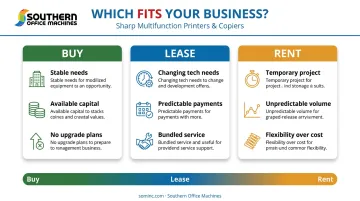
Not every business should lease. It depends on your capital position, your growth plans, and how predictable your print volume really is.
Buying outright makes sense when:
- Your equipment needs are stable and long-term
- You have available capital and want to avoid financing costs
- You don't anticipate needing to upgrade for several years
Leasing works best when:
- Technology needs change every 3-5 years and staying current matters more than ownership
- Predictable monthly payments suit your budget better than a large upfront purchase
- Bundled maintenance and support simplify vendor management
Short-term rental fits better when:
- You need equipment for a temporary project or event
- Your volume is unpredictable
- You're willing to accept a higher monthly cost in exchange for flexibility
Buying and renting sit at opposite ends of the spectrum, with leasing occupying the middle ground most businesses actually need.
Rather than guessing which category fits, a professional workflow assessment removes the ambiguity. Southern Office Machines' Business-to-Technology approach evaluates how your business actually operates — document volume, department needs, compliance requirements. From there, we recommend the right-sized equipment and financing structure for the lowest total cost of ownership.
Frequently Asked Questions
How does a copier lease agreement work?
You make fixed monthly payments to use equipment owned by the leasing company for a set term. The contract defines service inclusions, print volume allowances, and what happens when the term ends.
Is it cheaper to buy a copier or enter a copier lease agreement?
Buying can be cheaper long-term if you have stable needs and available capital, while leasing preserves cash flow and bundles service. The real answer depends on comparing total cost of ownership, not just the sticker price.
Can you get out of a copier lease agreement?
Yes, typically through paying the remaining balance, arranging a lease assumption or transfer, or negotiating a buyout. Review your termination clause first, since penalties typically apply.
How do you account for a copier lease agreement?
You typically expense FMV-style lease payments as they're paid, while $1 buyout leases often require recording the equipment as an asset and liability on your balance sheet under current accounting standards. Consult your accountant for the exact treatment your business needs.
What's the difference between an FMV lease and a $1 buyout lease?
An FMV lease offers lower monthly payments with no guaranteed ownership at term end. A $1 buyout lease costs more monthly but guarantees you own the equipment when the term is complete.
What should I look for before signing a copier lease?
Before signing, check these four items:
- Match your print volume allowance to actual usage
- Confirm exactly what the service agreement covers
- Understand the termination and renewal terms
- Request a full written fee disclosure