Introduction
Every business that prints, scans, or copies documents eventually faces the same decision: lease the copier or buy it outright. Both paths are common, and both work well for the right business.
The choice affects more than just this month's budget. It shapes your cash flow, your tax filing, and how quickly you can access newer scanning and security features over the next several years.
Many businesses struggle with this decision because the "right" answer changes based on print volume, growth plans, and available capital. This guide breaks down real costs and situational trade-offs so you can decide what fits your business, not someone else's.
Key Takeaways
- Leasing pays for equipment use over time; buying pays once for full ownership
- Monthly leasing costs are lower and tech upgrades easier, but you'll never own the machine
- Buying builds equity and may qualify for Section 179 tax breaks, but needs more capital upfront
- Cash flow, print volume, and refresh preferences should drive your decision, not habit
- A local provider who calculates total cost of ownership can save you from costly guesswork
Copier Lease vs. Buy: Quick Comparison
Here's how leasing and buying compare across the factors that matter most for your budget and workflow.
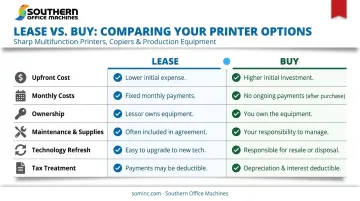
| Factor | Lease | Buy |
|---|---|---|
| Upfront Cost | Minimal, sometimes just a small initiation fee | Full purchase price due at signing |
| Monthly Costs | Fixed payment covering financing charges | No finance payment, but service plans often added separately |
| Ownership | Leasing company retains title throughout the term | Business owns the asset from day one |
| Maintenance & Supplies | Frequently bundled into the lease agreement | Arranged separately through a service contract |
| Technology Refresh | Easy upgrade every few years at term's end | Same machine until it's fully depreciated or fails |
| Tax Treatment | Payments often deducted as an operating expense | Eligible for Section 179 deduction or depreciation |
A quick note on financing structures: Equipment financing can sometimes offer 100% coverage with $0 down, but advance payments, fees, and insurance requirements still vary by contract. Always compare the total cash due at signing, not just the advertised monthly rate.
Maintenance is another area where assumptions can trip you up: some lease agreements bundle service and toner into the payment, while others don't. The same goes for purchased equipment, where a separate maintenance contract usually picks up the slack. Read the fine print before assuming either structure includes what you need.
What Is Copier Leasing?
Leasing works a lot like renting equipment instead of buying it. You pay a recurring fee to use the copier for a fixed term, typically without ever taking ownership.
The core appeal is cash flow. Instead of a large upfront outlay, you keep capital free for payroll, marketing, or inventory. Many lease agreements also bundle maintenance and consumables, which means less time spent tracking toner orders or scheduling repairs.
There are two common lease structures worth understanding:
- Fair Market Value (FMV) leases: Lower monthly payments, no automatic ownership. At the end of the term, you return the unit, renew, or buy it at its then-current fair market value
- $1 buyout leases: Higher monthly payments that amortize nearly the full cost of the machine, with a nominal $1 purchase option at the end
FMV leases favor flexibility. $1 buyout leases favor eventual ownership while still spreading out the cost.
Use Cases of Copier Leasing
Choosing between these structures often comes down to how predictable your printing needs are. Leasing tends to fit businesses that are growing, changing, or operating under compliance pressure:
- Offices with fluctuating print volume that don't want to overcommit to one machine size
- Companies that prioritize having the newest security and workflow features on hand
- Regulated industries like healthcare, legal, and government, where compliance and data-security requirements shift often enough that locking into old hardware creates risk
Leasing's popularity isn't new. A government-procurement trade group once estimated that roughly 80% of commercial and government copier acquisitions were structured as leases. That figure is dated, but it still reflects how deeply leasing is embedded in equipment strategy for organizations that value predictable costs over ownership.
What Is Buying a Copier?
Buying is a one-time capital expense. You pay for the machine, and it's yours, fully and immediately.
The biggest financial benefit is avoiding financing charges altogether. If you keep the copier for its full working life, the total cost often ends up lower than leasing the same equipment over an equivalent period. Ownership also means full control: modify it, resell it, or move it between departments without asking a leasing company's permission.
That same control extends to how you acquire the machine. New versus refurbished is where buying gets flexible: a new Sharp MFP delivers the latest security and speed specs, while a refurbished unit still delivers real value.
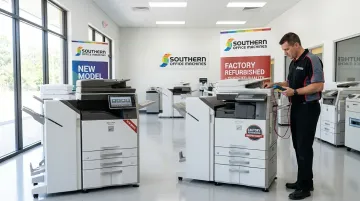
A refurbished unit, serviced by factory-trained technicians, can offer the same ownership benefits at a lower entry price. Southern Office Machines offers both, helping businesses land on the right machine for their actual budget instead of settling for less capability than they need.
Use Cases of Buying a Copier
Buying makes the most sense when:
- Print volume is stable and predictable, not seasonal or scaling quickly
- Capital is available and financing costs would otherwise eat into ROI
- Frequent technology refreshes aren't a business priority
Small back-office departments and low-volume users are classic examples. A five-person accounting team printing a few hundred pages a week doesn't need the newest color MFP every three years. They need reliable output and low total cost.
Before locking in that decision, though, one caution on lifespan claims is worth flagging: there's no verified industry-wide figure for "average copier lifespan." Manufacturer duty-cycle ratings describe maximum monthly workload capacity, not how many years a machine will last. A better approach is matching your actual monthly volume against the machine's recommended range, then evaluating service history and parts availability as it ages.
Copier Lease vs. Buy: Which One Is Right for You?
The decision comes down to four factors:
- Budget and cash flow: Can you absorb a large upfront cost, or does preserving capital matter more right now?
- Print volume: Is it steady, growing, or unpredictable?
- Refresh cycle: Do you want new equipment every few years, or are you comfortable running one machine for a decade?
- Growth trajectory: Are you scaling into new locations or departments soon?
Choose leasing if predictable monthly costs, bundled maintenance, and easy upgrades matter most to your team.
Choose buying if capital is available and this year's tax deduction matters to you. It also makes sense if you plan to run the machine for its full working life.
Some businesses don't pick just one. Companies with multiple departments or locations often use a hybrid approach: leasing high-volume production machines that need frequent refreshes, while buying lower-volume backup units that just need to work reliably for years.
Real-World Example: Making the Right Call
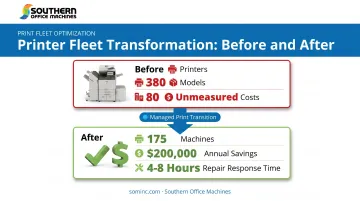
Washington State's Department of Ecology managed more than 380 printers across 80 different models for 1,500 staff, with little visibility into actual usage or cost. Rather than choosing a traditional lease or buy path, they shifted to a pay-per-page managed print model.
The switch paid off fast: $200,000 in annual hard-cost savings in the first year alone, a fleet reduced from 380 devices to roughly 175 machines, and repair response times cut to 4-8 hours.
The real lesson is specific: guessing your acquisition strategy without measuring actual usage gets expensive, regardless of whether managed print services fit your situation. Lease, buy, or blend both — let the decision follow data, not habit.
This is exactly the approach Sheldon Michaels brings to clients at Southern Office Machines. His Business-to-Technology method starts by learning how a company works, then calculates total cost of ownership before recommending a lease or purchase path. If your last equipment decision was more guesswork than analysis, request a consultation to see what the numbers actually say.
Conclusion
Neither leasing nor buying wins in every situation. The right path depends on your cash flow priorities, your print volume, and whether you value flexibility or long-term control more.
What matters most is getting an honest total cost of ownership calculation before you sign anything. Southern Office Machines has served Metro Atlanta and Marietta since 1985, helping businesses weigh these trade-offs firsthand. Contact us for a no-pressure comparison of leasing and buying costs based on your specific print volume.
Frequently Asked Questions
Is it better to purchase or lease a copier?
There's no universal answer. It depends on your cash flow priorities, tax strategy, and how often you want to upgrade equipment. A total cost of ownership calculation is the best way to decide.
How long is a typical copier lease term?
Most copier leases run between 36 and 60 months, though actual terms vary by financing provider and contract structure. Always confirm the specific range with your provider.
What happens at the end of a copier lease?
You typically have three options: return the equipment, purchase it at fair market value or a fixed price, or renew the lease. Some contracts also allow rolling into a new lease with updated equipment.
Does buying a copier still include maintenance and service support?
Yes. Purchased copiers can be covered under a separate maintenance agreement for parts, toner, and repairs. Southern Office Machines offers monthly, quarterly, or annual plans for owned equipment.
Can I deduct copier lease payments or purchase costs on my taxes?
Lease payments under a true lease are often deducted as an operating expense, while purchases may qualify for a Section 179 deduction or standard depreciation. Consult a tax advisor to confirm which applies to your situation.
What factors should a small business consider before deciding to lease or buy a copier?
Weigh your available budget, current and projected print volume, growth plans, and how important access to the newest technology is to daily operations. Reviewing these factors together will point you toward the option that fits your business best.