Get it right, and you preserve capital while keeping operations running smoothly. Get it wrong, and you're either locked into payments that exceed the printer's value or sitting with a capital asset that's obsolete before it's paid off.
This guide breaks down both options clearly, offers a side-by-side comparison, and gives you a practical decision framework — so whether you're a growing Atlanta startup or an established firm with stable print volume, you can choose with confidence.
Key Takeaways
- Buying gives you full ownership, no recurring equipment payments, and potential Section 179 tax deductions — best for stable, high-volume operations with capital available.
- Leasing or renting offers lower upfront costs, predictable monthly payments, and maintenance often bundled in — ideal when cash flow and flexibility matter most.
- Variable print volumes, tight capital, or frequent technology upgrades all point toward leasing.
- Buying pays off over time when print needs are consistent and you have support resources in place.
- The right choice depends on your budget, volume, growth trajectory, and maintenance capacity.
HP Printer Lease vs. Buy: Quick Comparison
The right choice depends on your budget structure, how often your needs change, and how much responsibility you want for maintenance. This table covers the key differences at a glance.
| Factor | Leasing / Renting | Buying Outright |
|---|---|---|
| Upfront Cost | Low to none | Moderate to high |
| Ownership | Remains with provider | Full company ownership |
| Monthly Cost | Fixed recurring payment | None after purchase (supplies only) |
| Maintenance | Often bundled in | Company's responsibility |
| Technology Upgrades | Available at end of term | Must purchase a new unit |
| Tax Treatment | Payments typically deductible as operating expenses | May qualify for Section 179 deduction |
| Flexibility | Scalable, easier to upgrade | Fixed asset, harder to switch |
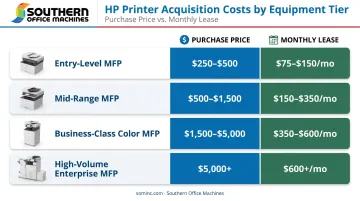
Typical purchase price ranges by equipment tier:
- Entry-level monochrome MFP (low-volume, single workgroup): $250–$500
- Mid-range workgroup MFP (color or higher-speed monochrome): $500–$1,500
- Business-class color MFP (departmental, 25–45 ppm): $1,500–$5,000
- High-volume or production MFP (enterprise/fleet grade): $5,000+
For leasing, dealer benchmarks from AIS show general monthly ranges of $75–$150/month for entry-level MFPs, $150–$350/month for mid-range, and $350–$600+/month for high-volume equipment on 36–60 month terms. These are general benchmarks. Actual quotes vary by model, term length, and included services.
What Does Buying an HP Printer Mean for Your Business?
Buying means your business pays the full price — either in cash or through equipment financing — and takes immediate ownership. This is distinct from leasing: with a purchase, the asset goes on your balance sheet from day one.
Core Advantages of Buying
- Printer appears as a depreciable asset on your balance sheet
- No recurring equipment payments after the purchase is complete
- No page caps or overage fees — print as much as your workflow demands
- Freedom to add paper trays, use third-party supplies, or modify as needed
- Maintenance agreements on your own terms — monthly, quarterly, or annually — rather than locked into a lease's schedule
Section 179 Tax Benefit
The Section 179 deduction can eliminate the printer's full purchase cost from your taxable income in year one. For tax years beginning in 2026, IRS Publication 946 sets the maximum Section 179 expense deduction at $2,560,000, with a phaseout beginning at $4,090,000 in property placed in service. Office equipment — including printers — qualifies as tangible personal property under this provision.
This means an eligible business could deduct the full purchase price of a printer in the year it's placed in service, rather than depreciating it over several years. P.L. 119-21 also reinstated a 100% bonus depreciation allowance for certain qualified property acquired and placed in service after January 19, 2025.
Consult a tax professional to confirm eligibility based on your specific situation, business-use percentage, and income limitations.
Disadvantages of Buying
- High upfront capital requirement
- Full responsibility for maintenance and unexpected repair costs
- Technology obsolescence risk — a printer purchased today may need replacing in a few years as newer models emerge
Use Cases for Buying
Buying works best when your business has:
- Stable, predictable print volume — matching your monthly output to a model's recommended range (not just its maximum duty cycle) is what determines equipment longevity
- Available capital or access to affordable equipment financing
- In-house IT or maintenance resources to handle service without depending on a vendor
- A long planning horizon — law firms, accounting offices, and healthcare providers with consistent document workflows are strong candidates
What Does Leasing or Renting an HP Printer Mean for Your Business?
With a lease or rental, your business pays a recurring monthly fee to use equipment owned by the provider. The key distinction: a short-term rental offers month-to-month flexibility, while a formal lease locks in a fixed term (typically 12–48 months) in exchange for lower monthly payments.
HP's All-In Plan — starting at $7.99/month — is a consumer-facing subscription that bundles an ink-based printer, automatic ink delivery, and 24/7 support. It targets home and small-office users, not enterprise print environments. Business leases through local office equipment providers offer far more tailored terms for commercial workloads.
Core Advantages of Leasing
- Low to no upfront cost preserves working capital for higher-priority business needs
- Fixed monthly payments make budgeting straightforward and predictable
- Maintenance is often bundled in, reducing surprise repair costs
- At term end, you can upgrade to a newer model without managing equipment disposal yourself
These advantages are only part of the picture — how lease payments are treated at tax time can meaningfully affect your total cost of ownership.
Tax Treatment of Lease Payments
Lease payments are generally deductible as ordinary and necessary business expenses in the year incurred — provided the agreement is a true lease, not a conditional sales contract. IRS Publication 535 clarifies that rent is deductible only when the taxpayer does not hold or expect to receive equity or title in the property.
This creates a different tax profile than buying: rather than a one-time deduction, leasing delivers consistent annual deductions across the term. Contract terms vary enough that consulting a tax professional before signing is worth the time.
Disadvantages of Leasing
- Total lease payments over the full term often exceed the purchase price
- No asset ownership at term end (unless a buyout option is exercised)
- Early termination penalties can be costly
- Some agreements include page volume limits or restrictions on supplies
Use Cases for Leasing or Renting
Leasing is often the smarter choice for:
- Startups and growing businesses that need to protect working capital
- Organizations with fluctuating print volumes that need scalability
- Government agencies and nonprofits whose budget cycles favor operating expenditures over capital expenditures
- Businesses in regulated industries (healthcare, finance, legal) that must stay current with equipment security standards
If your business falls into one of these categories, local expertise matters when structuring the right agreement. Southern Office Machines has served Metro Atlanta since 1985, offering factory-trained technician support, flexible maintenance agreements (monthly, quarterly, or annual), and a hands-on process that accounts for your actual workflow before recommending a term or model.
Lease vs. Buy HP Printer: Which Is Right for Your Business?
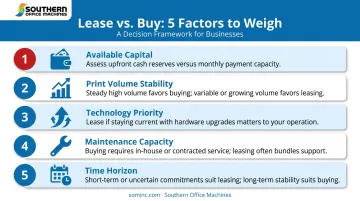
No formula produces the right answer automatically. What matters is how your specific situation maps to five key factors.
Five Factors to Weigh
- Available capital — Can you absorb a $449 to $4,979+ upfront cost, or does that capital need to stay liquid?
- Print volume stability — Is your monthly page count predictable, or does it swing with client workloads?
- Technology priority — How much does falling behind the latest generation of equipment affect your operations?
- Maintenance capacity — Do you have internal IT resources, or do you need a vendor to handle service?
- Time horizon — Are you planning for 5+ years of stable operations, or building a business that may look very different in 2 years?
Situational Recommendation Guide
Choose buying if:
- Print volume is consistently high and predictable month over month
- Capital is available or equipment financing is affordable
- In-house support can handle maintenance without vendor dependency
- Long-term total cost of ownership clearly favors ownership over cumulative lease payments
Choose leasing or renting if:
- Your business is scaling and capital needs to stay flexible
- You want predictable monthly expenses without maintenance surprises
- Staying current with the latest printer technology is operationally important
- Your budget structure favors operating expenses over capital expenditures
Two Atlanta-Area Scenarios
To see how these factors play out in practice, consider two common Metro Atlanta situations.
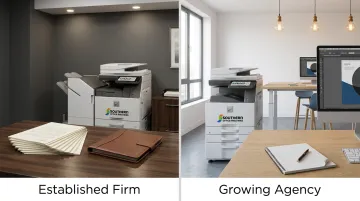
Scenario 1 — Established accounting firm: A Buckhead accounting office printing 5,000+ pages per month with a stable client base purchases a high-volume color laser MFP outright, deducts the cost under Section 179 in year one, and adds a maintenance agreement. Total cost of ownership over five years favors the purchase clearly.
Scenario 2 — Growing marketing agency: A Midtown agency leases a multifunction printer to keep capital free for hiring and client acquisition. At the end of the 36-month term, they upgrade to a newer model without a disposal headache — and their monthly payments have been fully deductible as operating expenses throughout.
Calculate Your TCO Before Deciding
Before committing either way, run a Total Cost of Ownership calculation over 3–5 years. Include:
- Purchase price or total lease payments over the term
- Toner and supply costs (cost per page × monthly volume × months)
- Maintenance agreement costs (purchased equipment) or bundled service value (leased)
- Potential upgrade or replacement costs at the end of the horizon
This single exercise — comparing apples to apples across both options — typically points clearly to one option. Keypoint Intelligence's bliQ TCO calculator offers structured TCO analysis for individual products and fleets if you want a dedicated tool.
Conclusion
The lease vs. buy decision for an office printer comes down to your business's financial position, print demands, and operational priorities. Businesses that value asset ownership, long-term savings, and operational stability often favor buying. Those that prioritize flexibility, low upfront costs, and access to current technology lean toward leasing or renting.
To get a clear, numbers-based recommendation tailored to your Metro Atlanta operation, reach out to Southern Office Machines at 770-919-8989. The team applies a Business-to-Technology approach: they learn your workflow, evaluate your volume, and calculate your total cost of ownership across all three acquisition paths (purchase, lease, or rental) before recommending anything. No pressure, no predetermined solution.
Frequently Asked Questions
Is renting a printer worth it?
Renting makes sense for businesses that need to preserve cash, want maintenance included, or require short-term flexibility. It may cost more than buying over a longer horizon, so the value depends on your print volume, budget, and how long you expect to use the equipment.
What is the HP printer rental plan?
HP's All-In Plan is a consumer subscription starting at $7.99/month that bundles an ink-based printer, automatic ink delivery, and 24/7 support. It targets home and small-office users. Business leases through authorized dealers operate on separate terms, offering more flexibility and customization for commercial environments.
How much does it cost to lease a printer?
Monthly lease costs vary based on model, term, and included services. General dealer benchmarks run $75–$150/month for entry-level MFPs, $150–$350/month for mid-range, and $350–$600+/month for high-volume equipment on 36–60 month terms. Request a direct quote from a local provider for accurate, model-specific pricing.
What are the tax benefits of leasing a printer vs. buying one?
Purchased printers may qualify for the Section 179 deduction, allowing the full cost to be deducted in the year of purchase. Lease payments are generally deductible as operating expenses each year. The right choice depends on your tax situation; consult a tax professional.
Can I upgrade my printer during or at the end of a lease?
Most business lease agreements include an upgrade option at term end, and some allow mid-term upgrades for an adjusted payment. It's a practical option for businesses that want to stay current with the latest technology without locking into a single asset long-term.