Sound familiar? Plenty of Metro Atlanta businesses find themselves in exactly this spot: locked into a legally binding lease with equipment that no longer fits their workflow, or stuck with a provider that barely answers the phone anymore.
Here's the problem. A copier lease is a contract, not a suggestion. Stop paying, and you risk repossession, collection calls, and lasting damage to your business credit.
A copier lease buyout offers a way out that doesn't involve breaking the contract or your credit score. This guide covers what a buyout actually is, how the process works, when it makes financial sense, and what alternatives exist if a buyout isn't the right fit for you.
Key Takeaways
- A buyout pays off your remaining lease balance, letting you own the equipment or upgrade.
- Most buyouts convert into a new lease, not full contract freedom.
- Payoff amounts typically combine remaining payments and fair market value.
- Buyouts make the most financial sense later in a lease term, not right after signing.
- Rolling the payoff into a new lease can help you avoid a big upfront bill.
What Is a Copier Lease?
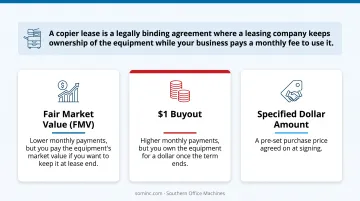
A copier lease is a legally binding agreement where a leasing company keeps ownership of the equipment while your business pays a monthly fee to use it. Most copier leases fall into one of three purchase-option structures:
- Fair Market Value (FMV): Lower monthly payments, but you pay the equipment's market value if you want to keep it at lease end.
- $1 buyout: Higher monthly payments, but you own the equipment for a dollar once the term ends.
- Specified dollar amount: A pre-set purchase price agreed on at signing.
What Happens at the End of a Standard Term?
When your lease matures, you generally get four choices: purchase the equipment, upgrade to newer gear, return the unit, or keep renting month to month.
Walking away isn't one of them. Stop paying before the term ends, and the leasing company can repossess the copier and report the default to business credit bureaus.
This is why a buyout is the smarter move when a lease stops working for your business.
What Is a Copier Lease Buyout?
A copier lease buyout is the option to pay off the remaining balance on an existing lease, either to take ownership of the equipment or to exit the contract early and switch providers.
A Buyout Trades One Lease for Another
Here's the misconception most business owners have: they assume a buyout gets them out of a lease entirely. In reality, most buyouts simply retire one obligation and replace it with another, ideally with better equipment, better service, or better terms.
If you buy out your lease to switch dealers, the new provider typically finances your replacement equipment and folds the old payoff into that new agreement. You simply trade an outdated lease for one on equipment that actually works.
How the Buyout Amount Gets Calculated
There's no single universal formula, but the approach used by major lessors like Canon Financial Services offers a good model. Their prior-to-maturity purchase clause charges all remaining payments owed, plus the equipment's fair market value, plus applicable taxes and fees, according to Canon Financial Services' Total Solution Lease Agreement.
That's different from a standard end-of-term purchase option, which only charges the pre-set price without re-adding the full remaining payment stream. The key distinction:
| Option | When Available | Cost Basis |
|---|---|---|
| Lease-end purchase option | Only once the scheduled term ends | Pre-set purchase price only |
| Buyout | At any point during the term | Remaining payments owed plus residual value |
This timing flexibility matters. If you're at month 24 of a 60-month lease with a copier that can't keep up, you don't have to wait three more years to make a change.
Avoiding a Big Upfront Bill
Most businesses assume a buyout means writing a large check on the spot. In practice, a new provider like Southern Office Machines can often structure the deal so the payoff amount rolls directly into the new lease agreement. You start fresh with new equipment, and the old balance disappears into your monthly payment instead of your bank account.
How Does a Copier Lease Buyout Process Work?
Once you decide a buyout makes sense, the mechanics are fairly straightforward on your end, even with several parties working behind the scenes.
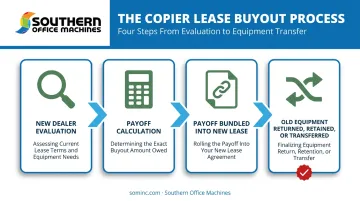
- A new dealer evaluates your needs and proposes replacement equipment plus a service plan.
- The new leasing company calculates your old payoff using a quote from your current lessor.
- The payoff gets bundled into the new lease, so you sign one agreement covering both the old balance and the new equipment.
- Old equipment gets returned, retained, or transferred, depending on which buyout type applies.
The "Stream of Payments" Method
Many leasing companies handle payoff using the stream of payments method. Instead of you writing a check to your old lessor, the new leasing company sends payment directly, covering whatever remains on the original contract.
You never touch the money; it moves between leasing companies while you focus on getting your new equipment installed. GreatAmerica's own end-of-lease guidance describes a similar structure built around remaining payments and open items.
Common Types of Copier Lease Buyouts
Dealers generally describe buyout transactions using a handful of working categories. Labels vary by provider, but the structures tend to look like this:
- Customer Buyout: You initiate the payoff directly with your current lessor, typically to switch vendors. Once it's paid off, you own the equipment outright.
- Vendor Buyout: Your new dealer purchases the remaining contract from your old leasing company. Ownership transfers to the vendor, and no new lease gets issued for that specific unit.
- Vendor Upgrade, Equipment Retained by Dealer: The new leasing company pays your dealer an incentive tied to financing your new contract. In exchange, the dealer keeps your old equipment instead of shipping it back.
- Vendor Upgrade, Equipment Returned: Same incentive structure, except your old equipment goes back to the original leasing company rather than staying with the dealer.
Which structure applies depends on your existing lease terms and what your new provider is willing to negotiate. At Southern Office Machines, we walk Metro Atlanta customers through each option before any new paperwork gets signed.
When Does a Copier Lease Buyout Make Sense?
A buyout isn't automatically the right move just because you're unhappy with your current setup. It makes sense when specific conditions line up.
Signs a Buyout Is Worth Exploring
- Your equipment can't keep up. Outdated copiers jam constantly or lack features you now need, like advanced scanning or cloud integration.
- Service has gone downhill. This happens often when a provider gets acquired and support quality drops.
- A better deal exists elsewhere. Sometimes a competing dealer's total package beats what you're currently paying.
Timing Matters More Than You'd Think
Recognizing these signs is only half the equation—timing affects the math too. Buyouts tend to make more financial sense the deeper you are into a lease term. Early on, the remaining balance plus the equipment's fair market value can add up to more than the new deal is worth.
There's no fixed industry cutoff for this; it depends entirely on your contract and residual terms. Getting an actual payoff quote from your lessor, rather than guessing, is the only reliable way to know where you stand.
If you're only a few months into your lease, that payoff often exceeds what you'd save by switching. In that case, it's smarter to wait, revisit termination language, or address service problems with your current provider first.
Look at Total Cost, Not Just the Lease Payment
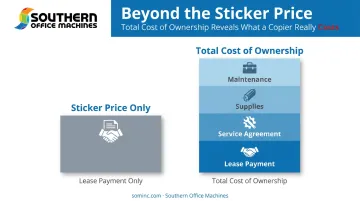
A comparison that only looks at monthly lease payments misses half the picture. Service agreements, supplies, and maintenance often make up a substantial chunk of your real copier costs.
This is the thinking behind Sheldon Michaels' Business-to-Technology approach at Southern Office Machines: before recommending any move, he evaluates total cost of ownership rather than sticker price alone. A machine with a slightly higher lease payment but lower service costs can save more money over time.
Alternatives to a Copier Lease Buyout
A buyout isn't the only path out of a lease that no longer works. A few other options are worth checking first.
- Review your contract for early termination language. Some leases allow an exit if your provider missed agreed service standards, but most standard commercial leases are written as non-cancelable—check the fine print before assuming this option applies.
- Look into subleasing or lease assumption. An assumption clause may let another company take over your payments, though most leasing companies require prior written consent first.
- Consider a straight early payoff. This ends the contract without a new lease attached, but you'll still need a separate plan for your next copier.
Weigh these trade-offs against a buyout before deciding which path fits your situation.
Why Work With a Local, Experienced Provider for Your Buyout
Navigating a lease buyout means comparing payoff quotes, financing structures, and equipment options all at once. That's a lot to sort through alone, especially when your existing contract is managed by a national call center.
Southern Office Machines has served Metro Atlanta and Marietta since 1985, which means walking clients through lease transitions is nothing new for us. A locally owned provider can:
- Give you direct answers, not a call queue routed to a different rep every time.
- Send factory-trained technicians who know Sharp equipment thoroughly, rather than a generalist covering a dozen brands.
- Back new equipment with a lowest price guarantee, so the new lease side of your buyout starts out competitively priced.
If your current lease no longer fits, whether the equipment's outdated or your provider's service has slipped, it's worth having someone review your actual numbers first. Request a no-obligation consultation with Southern Office Machines.
We'll review your current lease terms and help you determine whether a buyout makes sense, or if another option saves you more.
Frequently Asked Questions
Is it better to buy or lease a copier?
It depends on your cash flow, how often you want to upgrade, and your tax situation. Leasing preserves capital and keeps equipment current, while buying builds equity in a machine that will eventually depreciate.
Is a copier lease an operating lease?
Most standard FMV copier leases are structured as operating leases, while $1 buyout leases function more like financing arrangements. Under FASB's lease accounting standard, classification hinges on five specific criteria, not the label on your contract.
How much does a copier lease buyout typically cost?
It depends on your remaining payments and the equipment's residual value, plus applicable taxes or fees. Always request a formal buyout quote from your current lessor instead of estimating the number yourself.
How long does a copier lease buyout take to complete?
Timelines vary by lessor and paperwork complexity, but a well-coordinated buyout with a new provider can often wrap up within a few weeks once payoff details are confirmed.
Will buying out my lease early hurt my business credit?
A properly structured buyout, where your new lease covers the payoff directly, generally shouldn't hurt your credit. Defaulting on payments instead is what causes real damage.
What happens to my old copier after a buyout?
Depending on the buyout type, your old equipment gets returned to the original leasing company, kept by the new dealer, or retained by you once ownership transfers.