Introduction
Most businesses sign photocopier service contracts without reading past the first page. The result? Surprise bills for repairs they assumed were covered, toner deliveries that never arrive automatically, and auto-renewal clauses that lock them in for another year before they realize what happened.
This guide covers what you need to know before you sign:
- What a photocopier service contract template should include
- The three main contract structures and how they differ
- What's genuinely covered versus excluded
- How to evaluate costs so there are no surprises
Whether you're managing one Sharp MFP or a fleet of multifunction devices across multiple departments, the right service agreement directly affects your uptime and your operating budget.
Key Takeaways
- Service contracts typically cover labor, parts, and consumables — but exclude paper, staples, networking issues, and user-caused damage
- The three main contract types are cost-per-copy, flat-rate, and time-and-materials, each suited to different usage volumes
- Every contract should define response times, exclusions, PM schedules, and escalation terms
- B&W CPC rates run $0.015–$0.020; color runs $0.075–$0.140 — use both as negotiation benchmarks
- Factory-trained technicians and local service presence matter as much as the headline rate
What Is a Photocopier Service Contract?
A photocopier service contract is a formal agreement between a business and a service provider covering maintenance, repairs, parts, and often consumables — in exchange for a predictable monthly or per-page fee.
The core value is risk transfer. Instead of absorbing unpredictable repair bills whenever something breaks, you convert that exposure into a defined, manageable cost. That predictability matters for budgeting, and the reduced downtime matters for operations.
Service contracts are not the same as manufacturer warranties. A warranty covers defects during a limited initial period. A service contract covers ongoing maintenance, wear-and-tear repairs, and supplies throughout the equipment's working life — well after the warranty has expired.
Typically, a service contract includes:
- Labor for routine, preventive, and remedial work
- Parts replacement for wear-and-tear components
- Testing, adjustment, and cleaning
- Firmware updates and calibration
Canon describes this as a defined maintenance scope covering labor through firmware updates. Xerox frames it as keeping equipment in good working order through repair and parts replacement. Either way, you're purchasing a defined service outcome — not just access to a technician when something goes wrong.
Types of Photocopier Service Contracts
Choosing the right contract structure depends on your print volume, budget predictability needs, and equipment age.
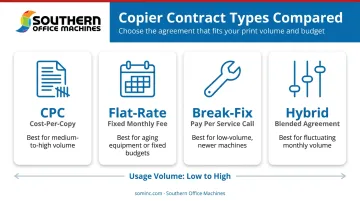
Cost-Per-Copy (CPC) Agreements
CPC contracts charge a fixed rate per page printed — typically separate rates for black-and-white and color. Toner, parts, labor, and preventive maintenance are bundled into that per-page rate, so your cost scales directly with usage.
This is the most common model for medium-to-high volume environments. Public contracts from Xerox show B&W rates of $0.015–$0.020 and color rates of $0.075–$0.140, depending on device class and coverage scope. Multiply your average monthly page count by the applicable rate to estimate your monthly service cost.
Flat-Rate Service Agreements
A flat monthly fee covers all service calls, labor, and parts regardless of how often the machine is serviced. This works well for older equipment prone to frequent issues, or when absolute budget predictability is the priority.
The downside: if your machine rarely breaks down, you may overpay relative to actual service consumed.
Time-and-Materials (Break-Fix) Agreements
No monthly fee. You pay only when service is needed: hourly labor plus parts per call. Southern Office Machines offers break-fix alongside structured maintenance plans, so customers aren't locked into coverage they don't need.
Break-fix suits low-volume users with reliable, newer equipment. The risk is cost volatility: one major repair can quickly exceed what a full year of preventive coverage would have cost.
Hybrid models also exist: a base flat fee with CPC billing above a certain volume threshold. Before committing, ask your provider which structure fits your average monthly page count — and whether a hybrid option is available.
A quick way to compare your options:
- CPC: Best for predictable, medium-to-high volume print environments
- Flat-rate: Best for aging equipment or teams that need fixed monthly costs
- Break-fix: Best for low-volume users with newer, reliable machines
- Hybrid: Best when volume fluctuates significantly month to month
What Should a Photocopier Service Contract Template Include?
Every photocopier service contract template should contain these core clauses. Missing or vague language in any of them is where disputes start.
Equipment Identification and Scope
List every covered machine by make, model, and serial number, along with the specific locations or departments included. Vague scope language like "all office copiers" without serial numbers creates disputes about whether a specific device is covered when it breaks down.
Service Response Time Guarantees
A well-drafted contract defines both maximum response time and resolution time commitments in writing, not just verbally promised. Public benchmarks are instructive: Ricoh cooperative contracts commit to 4 business hours in major metro areas and 8 hours beyond specified locations. Xerox's federal schedule differentiates between critical and non-critical devices with repair windows of 4, 9, or 16 working hours.
Response time is a key differentiator between providers. Whatever a salesperson promises verbally, get it documented in the contract itself.
Preventive Maintenance Schedule
The contract should specify:
- How frequently scheduled maintenance visits occur
- What those visits include (cleaning, inspection, wear-item replacement)
- How visits are documented and reported
Preventive maintenance is what separates a genuine service agreement from a reactive repair arrangement. Frequency varies by device model and usage volume; some manufacturers trigger PM by page counts rather than calendar intervals.
Supplies Coverage Terms
Confirm exactly which consumables the contract covers:
- Toner cartridges (specify B&W and each color: C, M, Y, K)
- Drums, fuser units, transfer belts, waste toner bottles
- Whether supply replenishment is automated or requires a customer request
Certain agreements now include remote monitoring with automated supply delivery. Others require the customer to call in. Whichever applies, the contract should state it clearly — ambiguity here leads to stock-outs at the worst possible times.
Exclusions and Limitations Clause
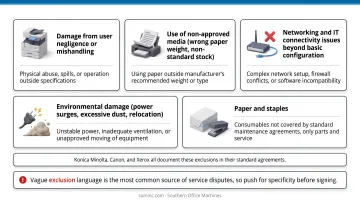
An explicit exclusions section is non-negotiable. Standard exclusions across manufacturer agreements include:
- Damage from user negligence or mishandling
- Use of non-approved media (wrong paper weight, non-standard stock)
- Networking and IT connectivity issues beyond basic configuration
- Environmental damage (power surges, excessive dust, relocation)
- Paper and staples
Konica Minolta, Canon, and Xerox all document these exclusions in their standard agreements. Vague exclusion language is the most common source of service disputes, so push for specificity before signing.
Pricing, Billing, and Escalation Terms
The billing section should cover:
- Monthly or per-page rate
- Overage pricing above any included volume
- Annual rate escalation clauses (CPI-linked or fixed percentage)
- Invoicing cycle and billing method
Negotiate a cap on annual rate increases and document escalation terms explicitly. Canon's agreements, for example, preserve charges for excess usage, supply freight, and toner coverage adjustments — any of which can add up significantly over a multi-year term.
Contract Term, Renewal, and Termination Provisions
Before signing, confirm the contract addresses:
- Initial term length (commonly 1–3 years)
- Auto-renewal conditions and the notice period required to cancel
- Early termination fees and how they're calculated
Auto-renewal clauses with short cancellation windows — sometimes as little as 30 days — are a consistent frustration for businesses. Read this section carefully before signing. Once the renewal date passes, your options narrow considerably.
What's Covered vs. What's Not Covered
What's Covered vs. What's Not Covered
What's Typically Covered
Most comprehensive service agreements include:
- On-site labor for repairs and troubleshooting
- Replacement parts for normal wear and tear
- Toner, drums, fusers, developer, transfer belts, and waste toner
- Scheduled preventive maintenance visits
- Remote monitoring software to proactively flag issues (now standard in most commercial agreements)
What's Typically Not Covered
Standard exclusions across major manufacturer contracts:
- Paper and staples — universally excluded
- User-caused damage — misuse, dropped equipment, improper media
- Network/IT connectivity issues — typically beyond basic setup; often requires a separate IT services agreement
- After-hours emergency service — available as an add-on in most agreements, not included by default
- Power surge or environmental damage
A practical example: using the wrong paper stock that causes repeated fuser damage is typically a billable repair, not a covered claim. Your contract's media specification clause is what determines who pays for that visit.
Gray areas worth negotiating explicitly:
| Item | Why It Matters |
|---|---|
| After-hours service | Standard agreements often exclude evenings and weekends |
| Connectivity support | Network troubleshooting may fall between copier and IT contracts |
| Rush supply shipping | Remote monitoring can eliminate this cost; manual requests may not |
| Loaner equipment | Some manufacturer agreements trigger a loaner unit after a set number of consecutive business hours down. Ask for a specific threshold written into your contract. |
How Much Does a Photocopier Service Contract Cost?
Cost depends on machine type, monthly print volume, and coverage level. Here's what public contract data shows:
| Contract Example | B&W CPC | Color CPC |
|---|---|---|
| OU/Xerox (high-volume floor units) | $0.015 | $0.075 |
| OU/Xerox (desktop models) | $0.020 | $0.100 |
| Xerox federal schedule | $0.016 | $0.140 |
These are specific public contracts (not a market average) but they're useful negotiation benchmarks. A business printing 10,000 B&W pages monthly at $0.018/page pays roughly $180/month for service; add color volume at $0.10/page and costs rise quickly.
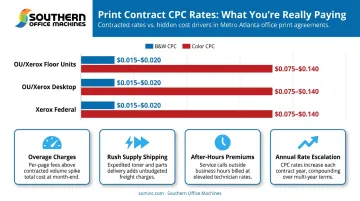
Hidden cost drivers that inflate total spend:
- Overage charges when monthly volume exceeds the contracted threshold
- Rush supply shipping when automated replenishment isn't active
- After-hours service call premiums
- Annual rate escalation over a 3-year term
Always calculate total cost of ownership across the full contract term, not just the monthly headline rate. Model low, expected, and high print volume scenarios before signing.
A lower click rate isn't automatically the better deal. Narrow service hours, no uptime restoration deadline, and freight charges can make a cheap contract more expensive in practice than one with a slightly higher rate and strong SLA guarantees.
How to Choose the Right Photocopier Service Provider
Three qualities matter most when evaluating providers:
- Technician credentials: Look for factory-trained technicians certified for your specific brand and model. Generic certification is not the same as model-specific training
- Contract transparency: Demand clear written guarantees with no hidden fees. If a provider can't share their exclusions list upfront, that's a signal worth heeding
- Local presence: A provider with local technicians can realistically meet 4-hour response commitments. Out-of-area providers rarely can
Provider tenure also matters. A company that has been servicing office equipment in your region for decades has built parts inventory, institutional knowledge, and service infrastructure that newer entrants typically lack.
Southern Office Machines, for example, has been serving Metro Atlanta and Marietta businesses since 1985, with factory-trained Sharp-certified technicians and maintenance agreements available monthly, quarterly, or annually. The Georgia Department of Community Health has described their service as "timely, responsive, and professional" — the kind of accountability a national provider rarely delivers.
Questions to ask before signing:
- What is your guaranteed on-site response time, and is it in the contract?
- Are your technicians factory-certified for this specific brand and model?
- What happens if my machine cannot be repaired — do you offer a loaner or replacement?
- Are all consumables listed explicitly in the agreement?
- What is your annual rate escalation policy and is there a cap?
Frequently Asked Questions
What is a photocopier service contract?
A formal agreement between a business and a service provider covering maintenance, repairs, parts, and often consumables for a defined period — in exchange for a predictable monthly or per-page fee. It transfers unpredictable repair costs into a manageable, recurring expense.
What are the types of photocopier service contracts?
The three main types are cost-per-copy (CPC), flat-rate, and time-and-materials (break-fix). CPC ties cost directly to actual usage and suits most regular-use offices; flat-rate works well for predictable high-volume environments; break-fix is pay-as-you-go with no ongoing commitment.
How much should a photocopier service contract cost?
Cost depends on machine type, print volume, and coverage level. Public contract data shows B&W rates of $0.015–$0.020 per page and color rates of $0.075–$0.140 per page — use these as benchmarks and request a quote based on your specific monthly volume.
How often should a photocopier be serviced?
Most service agreements schedule preventive maintenance based on page-count thresholds or equipment specifications rather than a fixed calendar interval — so actual visit frequency varies by how heavily you use the machine.
What should I look for when comparing photocopier service contracts?
Prioritize: guaranteed response times in writing, explicit inclusions and exclusions, technician certifications, annual escalation clauses, and the provider's local service capacity. If it's not written into the agreement, assume it isn't covered.
Can I cancel or modify a photocopier service contract early?
Most contracts have defined term lengths with early termination fees. Auto-renewal clauses typically require 30–90 days' written notice before the renewal date to cancel. Review termination terms before signing — not after the renewal window closes.