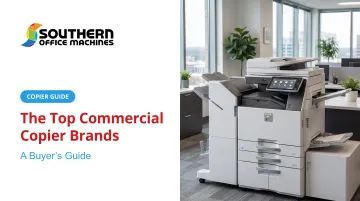
Today's commercial copiers aren't just copy machines. They're multifunction systems combining print, scan, copy, email, and cloud connectivity into a single device. That means the brand you choose directly affects daily workflow, document security, and what you'll actually spend over three to five years — not just the day you sign.
This guide covers the top five commercial copier brands, what genuinely sets each apart, and how to match the right system to your business.
Key Takeaways
- The top commercial copier brands are Sharp, Canon, Ricoh, Konica Minolta, and Xerox — each with distinct strengths for different business types and print volumes.
- Brand choice affects total cost of ownership, not just hardware price; toner, service, and downtime costs accumulate quickly.
- Security features, workflow integration, and local service quality matter as much as print speed.
- Leasing offers lower upfront costs and easier upgrades; buying suits stable, long-term print needs.
- A local authorized dealer can match your workflow to the right system, reducing costs and avoiding compatibility issues long-term.
What Makes a Great Commercial Copier Brand?
Name recognition isn't a buying criterion. A great commercial copier brand earns its reputation through product depth, documented reliability (think uptime rates and third-party repair frequency data), and a service infrastructure that keeps machines running when your business needs them.
Key metrics to evaluate any brand:
- Pages per minute (PPM): Measured via ISO/IEC 24734 standards for apples-to-apples comparison
- Monthly duty cycle: The manufacturer-stated maximum output — not a target for sustained daily volume
- Print resolution of 1,200 x 1,200 dpi is the current benchmark across most commercial A3 MFPs
- Security features: Encrypted storage, TPM 2.0, TLS 1.3, WPA3, LDAP/Active Directory authentication, and data erasure
- Cloud and mobile connectivity, plus enterprise application support
- Service network depth: Factory-trained technicians, local parts availability, and responsive on-site support
The five brands below were evaluated against these criteria. Each consistently leads in market trust, product range, and service infrastructure, making them the strongest starting points for any commercial copier purchase.
Top 5 Commercial Copier Brands
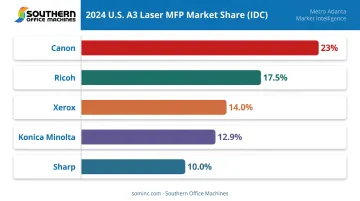
According to IDC's 2024 U.S. Quarterly Hardcopy Peripherals Tracker, Canon holds 23% of the U.S. A3 laser MFP market, followed by Ricoh at 17.5%, Xerox at 14.0%, Konica Minolta at 12.9%, and Sharp at 10.0%. Market share reflects deployment volume, not necessarily the best fit for your specific needs — here's what each brand actually delivers:
Sharp
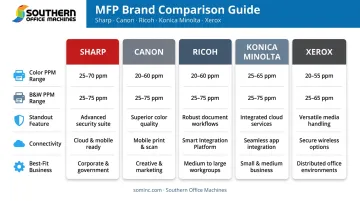
Overview: Sharp has manufactured commercial office technology for over a century, with a lineup spanning compact desktop copiers to high-volume multifunction systems. SMBs consistently choose Sharp MFPs for their intuitive touchscreen interfaces and strong digital imaging quality.
Print speeds (documented models):
- Color: 26–65 ppm (BP-50C series through BP-70C series)
- B&W: 65–75 ppm (BP-70M series)
What sets Sharp apart:
- OSA (Open Systems Architecture) connects MFPs directly to Box, Dropbox, Google Drive, Microsoft Teams, OneDrive, and SharePoint Online
- Sharp Security Suite delivers 256-bit AES encryption, up to 7-pass data overwriting, and Common Criteria Certified Data Security Kits
- 29 current-line models received Keypoint Intelligence Security Validation in February 2025
- ENERGY STAR certified models available, including the BP-70C65
| Spec | Detail |
|---|---|
| Color PPM | 26–65 ppm |
| B&W PPM | 65–75 ppm |
| Best For | SMBs and regulated industries needing workflow customization and strong security |
| Pricing | Available on request through authorized dealers |
Local note: Southern Office Machines is a Sharp-authorized dealer serving Metro Atlanta businesses since 1985, offering sales, leasing, rental, and factory-trained on-site service for Sharp MFP systems.
Canon
Overview: Canon has produced commercial office equipment for nearly 90 years. Their imageRUNNER ADVANCE DX series holds the top U.S. A3 laser MFP market share position — a track record built on print quality, reliability, and versatility across business sizes.
Print speeds (documented models):
- Color: 26–70 ppm (C3900 through C5800 series)
- B&W: 25–70 ppm (DX 4900 through DX 6800 series)
Where Canon excels:
- Preferred by businesses producing professional marketing materials or high-detail documents requiring consistent color accuracy
- uniFLOW Online provides cloud print and scan management with secure printing, cost accounting, and fleet management
- The imageRUNNER ADVANCE DX 4835i completed a 150,000-impression Keypoint Intelligence durability test
| Spec | Detail |
|---|---|
| Color PPM | 26–70 ppm |
| B&W PPM | 25–70 ppm |
| Best For | Businesses of all sizes prioritizing image quality and document workflow management |
| Pricing | Available on request through authorized dealers |
Ricoh
Overview: Ricoh has built its commercial copier reputation over 50 years on high-speed, heavy-duty performance. Their IM series is the go-to choice for large enterprises and organizations that can't afford printing downtime.
Print speeds (documented models):
- Color: 45–70 ppm (IM C4510 through IM C7010)
- B&W: 35–80 ppm (IM 3500 through IM 8000)
Why enterprises choose Ricoh:
- Ricoh's acquisition of DocuWare added document capture, transformation, and workflow automation at enterprise scale
- RICOH Smart Integration supports scan-to-email, mobile/tablet printing, and cloud workflow across the fleet
- Recognized as a Leader in the 2024 IDC MarketScape for Worldwide Cloud Managed Print
- High duty cycles make the IM series suited for mission-critical, continuous-output environments
| Spec | Detail |
|---|---|
| Color PPM | 45–70 ppm |
| B&W PPM | 35–80 ppm |
| Best For | Large enterprises with high-volume, mission-critical printing and digitalization goals |
| Pricing | Available on request through authorized dealers |
Konica Minolta
Overview: Konica Minolta covers the full spectrum from compact office MFPs to high-end digital presses. Their bizhub i-Series has accumulated more documented security certifications than most competitors — a key differentiator for regulated industries.
Print speeds (documented models):
- Color: 25–65 ppm (bizhub C251i through C651i)
- B&W: 45–65 ppm (bizhub 451i through 651i)
Konica Minolta's security edge:
- Nine bizhub i-Series devices hold HCD-PP 1.0 hardcopy device certification; firmware received Keypoint Intelligence Device Penetration Security Validation in March 2026
- bizhub SECURE Platinum for Government delivers encryption, data overwrite, and access-control services built for government environments
- bizhub SECURE Healthcare helps organizations address HIPAA/HITECH document requirements
| Spec | Detail |
|---|---|
| Color PPM | 25–65 ppm |
| B&W PPM | 45–65 ppm |
| Best For | Regulated industries — healthcare, government, finance, legal — requiring strong document security |
| Pricing | Available on request through authorized dealers |
Xerox
Overview: Xerox announced the Xerox 914 on September 16, 1959 — the first automatic, plain-paper commercial copier. Today, their lineup spans small-office MFPs to enterprise production systems, with one of the highest documented monthly duty cycles in the commercial segment.
Print speeds (documented models):
- Color: 20–70 ppm (VersaLink C7100 through AltaLink C8200)
- B&W: 25–72 ppm (VersaLink B7100 through AltaLink B8200)
What sets Xerox apart:
- McAfee Embedded Control provides runtime protection on VersaLink C7100 and B7100 series; optional Trellix Integrity Control prevents unauthorized executable code
- ConnectKey enables cloud printing, workflow automation, and mobile access across supported MFPs
- Xerox's document-imaging software portfolio earned Keypoint Intelligence's 2025 Smart Workplace Solutions Line of the Year
- AltaLink models support duty cycles up to 300,000 images/month
| Spec | Detail |
|---|---|
| Color PPM | 20–70 ppm |
| B&W PPM | 25–72 ppm |
| Best For | Businesses of all sizes prioritizing workflow automation, brand reliability, and nationwide service reach |
| Pricing | Available on request through authorized dealers |
How We Chose These Top Commercial Copier Brands
These five brands were selected on specific, verifiable criteria — not marketing reputation:
- Covers workgroup through enterprise A3 MFP speeds across the full product lineup
- Independently tested or certified by Keypoint Intelligence or comparable analyst programs
- Documents security controls — TPM, encryption, authentication, and firmware integrity — not just marketing claims
- Maintains factory-trained technician availability and a robust parts ecosystem
- Holds sustained recognition in IDC MarketScape and Keypoint Intelligence evaluations across multiple years
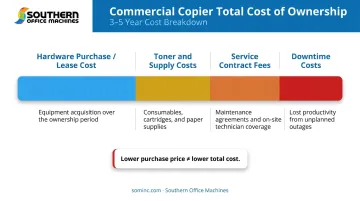
The most common buyer mistake: choosing based on price or brand familiarity without evaluating total cost of ownership (TCO) — hardware cost, toner and supply costs, service contract fees, and downtime costs combined.
A lower purchase price often costs more over three to five years once supply and service expenses are counted. Factor in TCO before signing anything.
Conclusion
Choosing the right commercial copier brand comes down to matching a machine's genuine strengths — speed, security, workflow integration, duty cycle — to your business's actual print volume, compliance requirements, and budget over time.
Getting that match right also depends on who stands behind the equipment. Factory-trained technicians, responsive on-site support, and flexible acquisition options (purchase, lease, or rental) are the difference between a copier that supports your operation and one that drains time and budget.
Southern Office Machines has been helping Metro Atlanta businesses find the right copier fit since 1985. Their Business-to-Technology approach means understanding your workflow before recommending equipment, then identifying the most efficient, cost-effective machine for your specific needs.
Contact Southern Office Machines to schedule a no-obligation consultation and get competitive pricing across the Metro Atlanta area.
Frequently Asked Questions
What are the top 5 copier brands?
The five most widely recognized commercial copier brands are Xerox, Canon, Sharp, Ricoh, and Konica Minolta. Each performs well in different contexts — the right fit depends on your business size, monthly print volume, and specific priorities like security compliance or workflow automation.
Should I lease or buy a commercial copier?
Leasing suits businesses that want lower upfront costs and the ability to upgrade technology as it evolves; lease terms typically run 36–60 months and may include service coverage. Buying makes more sense for organizations with stable, long-term print needs and the capital to purchase outright without impacting cash flow.
How do I choose the right commercial copier brand for my business?
Start by identifying your monthly print volume, required features (color, scanning, document security), and total budget, then match those to a brand's documented strengths. A workflow assessment with a local authorized dealer is the most reliable way to avoid over- or under-buying.
What is the average cost of a commercial copier?
Commercial MFP pricing varies significantly based on speed, features, and brand tier — most manufacturers don't publish list prices. Contact an authorized dealer for a quote specific to your volume and feature requirements.
How often should a commercial copier be serviced?
Service intervals depend on usage volume and the model's maintenance kit yields. Preventive maintenance — cleaning, parts inspection, and software updates — extends machine life and prevents downtime; consult your dealer for model-specific schedules.
What is total cost of ownership for a commercial copier?
TCO covers the purchase or lease price, toner and supply costs, service contract fees, and downtime costs. Unmanaged print environments can cost businesses more than 3% of annual revenue — which is why focusing solely on the hardware price is a common and costly mistake.